
Where Moisture in a Coastal Garage Floor Comes From
There are two sources: the air and the slab. Humid air is easy to notice. Moisture in the slab is harder to see, because concrete on the ground can pull water up from below and release it as vapor through the surface.
- From the air: Warm, humid air can leave a film of moisture on cool concrete, especially early in the morning.
- From the slab: Water vapor moving up through the concrete can sit under a coating and push it off over time.
- From the garage: Wet gear, an outdoor shower nearby or a leaking door seal can keep part of a floor damp.
How Installers Check the Slab
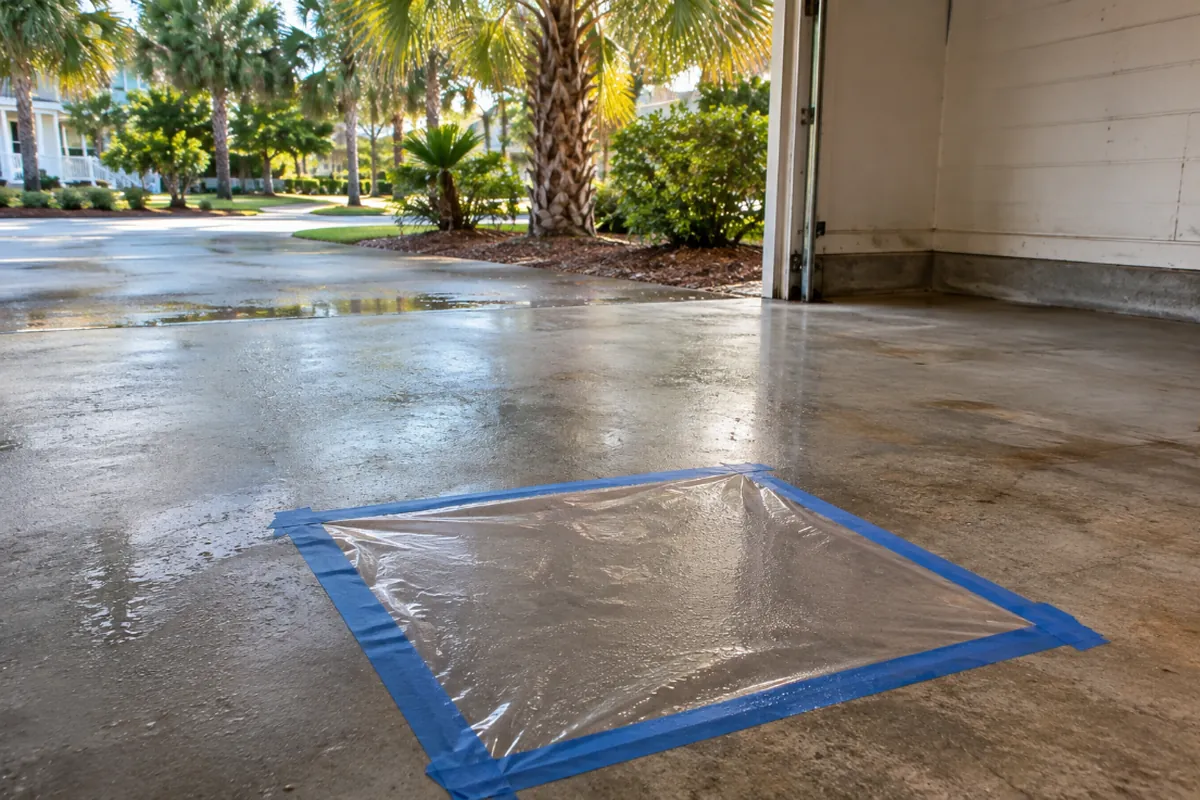
A careful installer checks the concrete before quoting, not on install day. The simplest check is the plastic sheet test: a square of clear plastic is taped to the slab and left in place, and moisture collecting under it points to vapor coming through the floor.
- Plastic sheet test: A quick look at whether moisture is coming up through the slab (ASTM D4263).
- Moisture meter: A reading of how much moisture is in the top of the concrete.
- Looking at the garage: Stains, white powder on the surface and damp corners all tell a story.
If a slab is carrying a lot of moisture, the fix is in the prep and the coating system, or in dealing with the water first. A coating on its own won't stop water coming up from below.
Timing the Install Around the Weather
Coatings cure on a chemical schedule, and temperature and humidity change that schedule. Coating makers publish the conditions their products need, including how far the concrete has to be above the dew point. A good crew follows those numbers and plans around afternoon storms.
- 1. Check the forecast: Pick a stretch without heavy rain for open or partly open garages.
- 2. Keep the garage closed: Once the coating is down, the door stays shut to keep out dust and moisture.
- 3. Respect cure times: Walk on it and park on it only when your installer says it's ready.
How a Cured Epoxy Floor Handles Coastal Humidity
Once cured, the coating seals the concrete. Water, sand and spills sit on top, where they sweep or rinse off, instead of soaking into the slab. That's a big part of why coated garages hold up well on the coast.
- Rinse it: Hose off sand and salt now and then, especially near the door.
- Dry the wet spots: Don't leave standing water under a cart or cooler for days.
- Watch the sun: For a garage that sits open, ask about a UV-stable topcoat, which keeps the floor from yellowing in direct sun.
Asked often
Coastal Humidity Questions
Can you install an epoxy floor in Myrtle Beach in summer?
Yes. Summer humidity doesn't rule out an install, but it changes the timing. The crew checks the slab and the conditions and plans the coating around them.
Will humidity make my epoxy floor peel later?
Humid air isn't usually what makes a cured floor peel. Peeling usually comes from weak prep, hot tires on a thin coating, or moisture coming up through the slab.
How do I know if my slab has a moisture problem?
Damp spots, white powder on the surface and coatings that bubble or lift are all signs. A plastic sheet test or a moisture meter reading at the estimate gives a better answer.
Is a coated garage floor slippery in humid weather?
A smooth coating can get slick when it's wet. Flake adds grip, and a grip additive in the topcoat helps more. See flake epoxy garage floors.
Does my garage need to be air-conditioned for an epoxy floor?
No. Most garages are coated without air conditioning. What matters is that the slab and air are within the coating's limits while it cures.
Sources
- ASTM D4263, Standard Test Method for Indicating Moisture in Concrete by the Plastic Sheet Method
- ArmorGarage, Epoxy vs. Polyurea vs. Polyaspartic Floor Coatings (2025)